Our coffees
The coffees of Ethiopia, direct from the source
Ethiopia grows more distinct coffees than almost anywhere on earth. As a licensed exporter, we buy directly from farmers, washing stations and estates, and focus on Grade 1 and 2 washed and natural lots, with Grades 3 to 5 for blends and larger orders.
What we supply
Grade and provenance
Two separate questions: what grade a coffee is, and where it comes from.
High grades
Grade 1 and Grade 2
Washed and natural lots with the fewest defects, for roasters and importers who buy on the cup. Each one comes with its region, process, crop year and lot details, and a sample where available, so you judge it in your own cupping.
Commercial grades
Grades 3 to 5
Washed and natural coffee for blends, house coffees and larger orders. Here the questions are practical: a cup profile that suits the blend, volumes you can plan around and a price that works. We propose coffees with those in mind.
Where it comes from
Washing station lots
Coffee from up to a thousand smallholder farms around one washing station. Distinctive regional character, new discoveries every season, and volume to match.
Single farm lots
Coffee traced to one farm, with a direct link between the price you pay and the premium the farmer receives.
Estate coffee
From a medium-size estate with its own washing station, with quality controlled from farm to shipment and direct, long-term trade.
Any of these can be a high-grade or a commercial lot. A single-farm coffee isn’t automatically better than a washing station lot: the grade and the sample tell you that.
Regions
Where we source most
Typical profiles to start the conversation. Every lot is different, so we judge each one on its own sample.
Yirgacheffe
Washed coffees known for jasmine-like florals, citrus and a light, tea-like body. Naturals are intensely fruity.
Gedeb
High-grown coffees from the south of the Yirgacheffe area: bright, floral and clean, washed or natural.
Sidama
More body and sweetness: stone fruit, brown sugar and softer florals, with bright acidity in washed lots.
Guji
Fruit-forward naturals with berry and citrus notes, and elegant, floral washed coffees.
Limu
Clean washed coffees from the western highlands, with gentle acidity, floral and spice notes and rounded sweetness.
Jimma
A large western origin, mostly natural coffees. Widely used in commercial grades and blends, with higher grades too.
Looking for another region, such as Harrar or the western highlands? Ask us.
Processing
Washed, natural and more
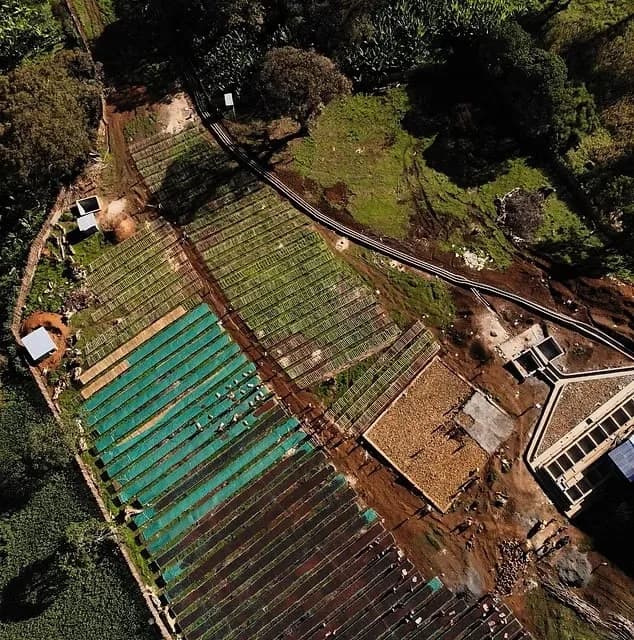
We handle processing and export preparation ourselves, from drying to hulling, sorting and grading. For many buyers, the choice between washed and natural matters as much as the choice of region.
Washed
The cherry is pulped, fermented and washed before the parchment dries on raised beds. Clean, bright and often floral in the cup.
Natural
Whole cherries dry in the sun on raised beds before hulling. Fruitier and heavier-bodied, the classic taste of southern and eastern Ethiopia.
Other methods
Honey, anaerobic and other experimental lots are produced in small volumes. Ask us what is available this season.
Grades
Ethiopian export grades, explained
Before any coffee leaves Ethiopia, the Ethiopian Coffee and Tea Authority grades it on physical quality (defects, size and appearance, 40%) and cup quality (60%). Export coffee runs from Grade 1, the best, to Grade 5. Specialty lots may also carry a Q1 (85 points and above) or Q2 (80 to 84.75 points) designation.
| Grade | Typical use | What to expect |
|---|---|---|
| Grade 1 | Specialty | The fewest defects and the top cup-quality marks in Ethiopia’s grading. The highest grade for washed and natural coffee. |
| Grade 2 | Specialty | Very few defects and a clean cup. Often the best balance of quality and price. |
| Grade 3 | Specialty or commercial | Can reach specialty quality, especially naturals. Otherwise a high-quality commercial coffee. |
| Grade 4 | Commercial | Sound everyday coffee for blends and larger volumes. |
| Grade 5 | Commercial | The last export grade, for blends built around volume and price. |
You’ll see names like “Yirgacheffe Grade 1 washed” or “Guji Grade 3 natural”: region, grade and process, in that order. A grade tells you about defects and cup quality, not flavour. Two Grade 1 lots from different regions can taste nothing alike, which is why the sample matters more than the label.
Varieties
Heirloom Ethiopia
Ethiopia is where arabica coffee comes from, and most of its coffee trees are local landraces and selections rather than the named varieties grown elsewhere. That is why Ethiopian lots are usually described as “Ethiopian heirloom”.
Behind that label are regional landraces, such as Kurume, Wolisho and Dega in the south, and selections developed by the Jimma Agricultural Research Center, such as 74110 and 74112. Where a lot’s varieties are known, we tell you.
Delivery and extras
How your coffee leaves Ethiopia
Sea freight
FOB Djibouti
Our price covers the coffee loaded on board your vessel at the port of Djibouti, Ethiopia’s main export route. You arrange the sea freight onwards.
Air freight
FCA Addis Ababa Bole International Airport
We hand the coffee to your air carrier at Bole International Airport. Useful for smaller or urgent shipments, samples and roasted coffee.
Sea or air
Freight arranged by us
Prefer one price to your port or airport? We can book the freight and quote it together with the coffee.
Optional extras
Packaging
GrainPro packaging
Hermetic GrainPro liners inside the export bags help keep moisture stable and protect quality in transit and storage.
Certification
Organic and Rainforest Alliance
Certified lots on request. Rainforest Alliance now includes the former UTZ programme. We share the certificate for your lot before you commit.
Questions buyers ask
Which grades can you supply?
Every Ethiopian export grade, washed or natural: specialty Grades 1 and 2, Grade 3, and commercial Grades 4 and 5. Which lots are available at each grade depends on the region and the harvest, so tell us what you need and we’ll tell you what we can offer this season.
Can I buy from a region that isn’t listed?
Often, yes. The regions above are where we source most, but we can also look for coffee from other areas, such as Harrar in the east or the western regions. Ask us.
What quality information comes with a lot?
Every export lot is inspected and graded by the Ethiopian Coffee and Tea Authority before it leaves the country. With each coffee we propose, we share the region, process, grade and crop year, together with the lot details and quality information we have for it, and samples where available.
When is the best time to buy?
Harvest runs roughly from October to January, varying by region and altitude. The first washed coffees can ship around the turn of the year, and most of the crop ships from about February onwards. Contracting early gives you the widest choice.
Tell us the coffee you’re looking for
A few lines are enough to start. We reply within one business day with questions or suitable coffees to consider.